
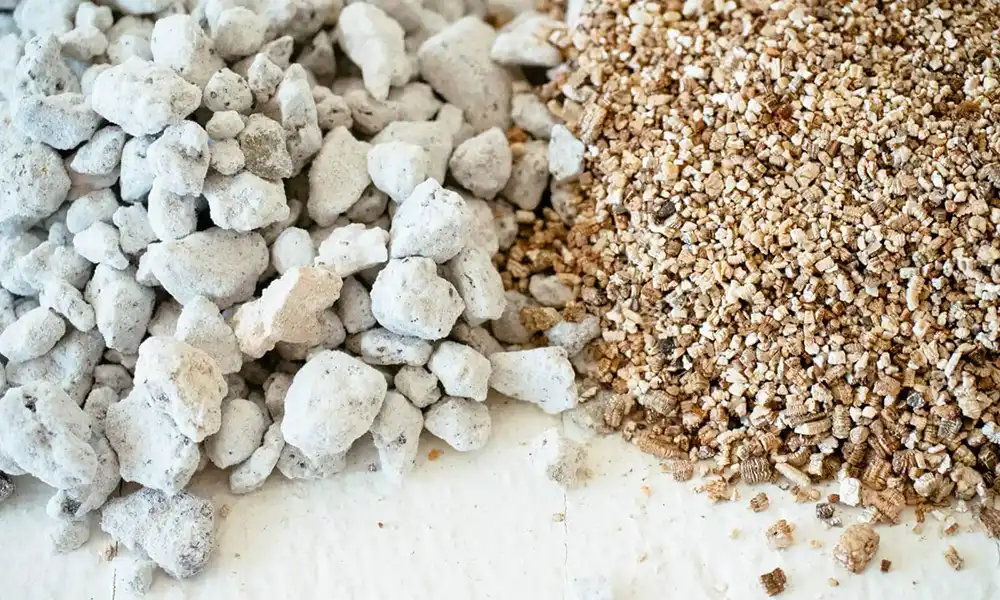
Perlite and vermiculite are both lightweight mineral soil amendments used in potting and propagation mixes, but they do different jobs.
If a growing mix stays wet, feels dense or needs more air around the roots, perlite is generally the better option. If a mix dries too quickly and needs to hold moisture for longer, vermiculite is usually more suitable.
That is the key distinction in the perlite vs vermiculite comparison:
- Perlite helps create a more open, aerated and free-draining mix.
- Vermiculite helps the mix retain more moisture and can also hold nutrients.
The right choice depends on what your existing growing medium needs to do differently.
Choose the Amendment That Fixes the Problem Your Soil Already Has
Before adding perlite or vermiculite, look at how your current growing medium behaves.
Does water drain through freely, or does the mix stay saturated for a long time? Does the surface dry quickly while seedlings or moisture-loving plants still need consistent moisture? Does the mix feel compacted, or are you watering more often than expected because it dries rapidly?
These observations help you choose the right amendment.
Perlite and vermiculite affect growing media differently, so adding the wrong one can push the mix further in the wrong direction.
What perlite does to drainage and soil aeration
Perlite is a lightweight expanded mineral commonly added to growing media to create more air space and improve drainage.
Dense potting mixes can settle closely together, leaving less room for air and slowing the movement of excess water.
Adding perlite helps interrupt that density. Its irregular particles create spaces that allow air and water to move more freely through the mix.
The result is generally a lighter, more open growing medium.
Perlite is therefore particularly useful when a potting mix is becoming compacted, holding excess moisture or providing less aeration than the plant requires.
What vermiculite does to moisture and nutrient retention
Vermiculite behaves differently.
Rather than being used primarily to increase drainage, it is valued for its ability to absorb and hold water. It can also help retain nutrients within the growing medium.
This makes vermiculite useful when moisture consistency matters more than faster drainage.
Seed raising is a good example. Seedlings have small root systems and can be more vulnerable when their growing medium repeatedly swings between moist and very dry.
Vermiculite can help the mix retain moisture for longer and reduce those rapid changes.
Perlite and vermiculite may look similar on a garden-supply shelf, but they are not interchangeable. One is mainly used to improve aeration and drainage, while the other increases moisture retention.
Perlite Wins When Roots Need More Air and Less Lingering Water
Roots need oxygen as well as water.
When a container medium becomes excessively dense or remains wet for too long, the air spaces surrounding the roots can be reduced. Improving the physical structure of the mix can help restore a better balance between air and moisture.
This is where perlite is particularly useful.
When to use perlite for fast-draining potting mixes
Perlite is worth considering when a growing medium needs to become:
- more open
- better aerated
- quicker to release excess water
- less prone to compaction
This makes it useful in container gardening, propagation and specialised potting blends where drainage is an important consideration.
Succulents provide a clear example.
Many succulents perform better in growing media that allow excess water to move away from the root zone rather than keeping roots continuously wet. If the existing mix is heavy and moisture retentive, adding perlite can help make it more open and free draining.
The same principle can apply to other container plants.
A gardener may begin with a general potting mix and find that, because of the container, watering routine or other ingredients, it stays wet longer than desired. Perlite can be used as one part of adjusting the structure.
For a closer look at the material itself, see our guide to what perlite is and why gardeners add it to soil mixes.
Perlite cannot correct every wet-pot problem on its own.
A container with poor drainage can still hold too much water. Frequent watering can keep even a free-draining mix overly wet. Conditions such as shade, temperature and container size can also affect how quickly a growing medium dries.
Treat perlite as one part of the overall growing setup rather than a complete solution.
Vermiculite Wins When the Mix Is Drying Before the Plant Is Ready
Now consider the opposite problem.
A propagation tray or potting mix may lose moisture faster than the plant requires. In that situation, adding more drainage is unlikely to help.
The priority becomes moisture retention.
That is where vermiculite can be more useful.
When vermiculite is better for moisture retention
Vermiculite is commonly used when a growing medium needs to hold water for longer while remaining suitable for plant growth.
It can be useful for:
- seed raising
- propagation
- moisture-loving plants
- growing mixes that dry unusually quickly
- situations where more consistent moisture is desirable
Good drainage does not mean maximum drainage in every situation.
A growing medium can drain too freely for a particular plant or growing setup.
If a seedling tray loses moisture very quickly, for example, the upper layers may dry before young roots can access enough water. A moisture-retentive amendment can make that environment easier to manage.
Vermiculite vs perlite for holding nutrients in the root zone
Vermiculite is useful not only because it retains water but also because it can help hold nutrients within the growing medium.
Perlite has a different primary role. It is mainly used to improve physical structure, aeration and drainage.
That means the choice between vermiculite vs perlite soil amendments should come back to function.
If you need to create more air space and encourage excess water to move through the root zone, perlite is the stronger candidate.
If you want the mix to retain more moisture and provide greater buffering between waterings, vermiculite is generally more appropriate.
We stock 100L Vermiculite Medium for gardeners and growers who need greater moisture retention in their growing media.
The Real Perlite vs Vermiculite Difference Is Drainage vs Moisture Retention
The comparison is easiest to understand when the two materials are viewed side by side.
| Decision factor | Perlite | Vermiculite |
| Primary role | Aeration and freer drainage | Moisture and nutrient retention |
| Best suited to | Dense or slow-draining mixes | Fast-drying mixes |
| Effect on structure | Creates a more open mix | Increases water-holding capacity |
| Common uses | Containers, drainage-focused mixes, succulents | Seed raising, propagation, moisture management |
| Weight | Lightweight | Lightweight |
| Direct substitute for the other? | No | No |
Perlite generally moves a growing medium towards greater aeration and faster drainage.
Vermiculite generally moves it towards greater moisture retention.
They are not direct substitutes.
A recipe that includes vermiculite may depend on its water-holding properties. Replacing it with perlite can make the mix dry more quickly.
The reverse also applies. If a growing medium uses perlite to maintain open pore spaces and improve drainage, replacing it with vermiculite changes how the mix handles water.
Start With the Plant, Not the Bag
There is no single answer to the question, “Which one should I buy?”
Different plants and growing situations require different moisture and aeration levels.
The better approach is to work backwards from the plant and the existing mix.
Perlite or vermiculite for succulents, seedlings and houseplants
Consider these common situations.
A succulent sitting in a heavy mix
The pot remains noticeably wet for days after watering, and the plant performs better in a faster-draining root environment.
The priority is opening the mix and improving the movement of air and excess water.
Perlite is generally the more suitable choice.
Seedlings in a shallow propagation tray
The small amount of growing medium dries rapidly, particularly near the surface.
Young roots and germinating seeds often need more consistent moisture.
Vermiculite may be more useful.
A moisture-loving houseplant
If the existing mix is already open and dries faster than the plant prefers, adding more drainage may make the problem worse.
A measured amount of vermiculite may help the mix retain moisture for longer.
A container filled with compacted potting mix
If the mix has settled, feels dense and needs more air space, perlite can help loosen its physical structure.
The important point is that the plant and the behaviour of the growing medium should guide the decision.
Your pot and watering routine can change the answer
The growing medium is only one part of the setup.
Container design also matters.
A pot with generous drainage holes behaves differently from a decorative container with limited drainage. A small black plastic pot in full sun may lose moisture much faster than a large container in a sheltered position.
Watering habits, plant size and the other components in the potting mix also affect the result.
Perlite and vermiculite do not work in isolation.
The goal is to create the right balance of air, moisture, stability and nutrients for the plant you are growing.
Sometimes the Best Answer Is Not Perlite or Vermiculite
Perlite and vermiculite are not always an either-or choice.
Some growing media can benefit from both because their functions are complementary.
Can you mix perlite and vermiculite together?
Yes.
A growing mix can use perlite to create additional air space while using vermiculite to retain more moisture.
Australian research provides one example of the two materials being used together. In a University of Technology Sydney propagation study, rooted Syzygium francissi shoots were transferred into a growing medium containing coco-peat, perlite and vermiculite in a 1:1:1 ratio, with 95% of the rooted shoots successfully acclimatising under greenhouse conditions.
The result applies to that particular propagation study rather than establishing a universal mixing ratio, but it demonstrates how perlite and vermiculite can perform complementary roles within the same growing medium.
The balance matters. Adding too much vermiculite to a mix intended for a plant that prefers rapid drying may increase water retention more than desired. Adding a large amount of perlite to a growing medium that needs to stay evenly moist may increase watering frequency.
There is no single ratio that is automatically right for every plant.
Start with the growing requirements instead.
Consider:
- the type of plant
- how quickly the current medium dries
- the container being used
- whether the mix has become compacted
- whether you are propagating young plants or growing an established specimen
Once those factors are clear, the balance between perlite and vermiculite becomes easier to judge.
Before You Buy, Diagnose How Your Current Mix Behaves
One of the easiest ways to choose between perlite and vermiculite is to observe how the growing medium behaves between waterings.
Water the plant thoroughly where appropriate, then monitor how quickly the mix drains and dries.
Choose perlite if your growing medium stays wet and compacted
Perlite is worth considering when you consistently notice that:
- water moves slowly through the mix
- the growing medium stays wet longer than the plant requires
- the mix has become dense or compacted
- greater air space around the roots would be useful
- the plant prefers a freer-draining substrate
Other issues may still need attention, particularly inadequate drainage holes or excessive watering, but these signs generally point towards a drainage-focused amendment.
Choose vermiculite if your growing medium loses moisture too quickly
Vermiculite is worth considering when:
- the growing medium dries faster than the plant prefers
- maintaining even moisture is difficult
- seeds or young plants need more moisture buffering
- the existing mix is already very free draining
- greater water retention would reduce rapid drying
The choice becomes much easier once you identify the direction in which the growing medium needs to change.
Compare the Growing Media, Then Choose the Direction Your Plants Need
Perlite and vermiculite are both lightweight mineral amendments, but their main functions are different.
Choose perlite when your growing medium is too dense, stays wet for too long or needs better aeration.
Choose vermiculite when the mix dries too quickly and greater moisture retention would help.
Some growing media can use both, provided the balance suits the plant, container and other ingredients in the mix.
Before adding either product, look at what happens after watering. Decide whether the mix needs to become more open and free draining or needs to retain moisture for longer.
You can compare our growing media range, including Fine Perlite 100 Litres and 100L Vermiculite Medium, when you are ready to adjust your mix.
Before You Tip Either One Into the Pot, Ask These Questions
Is perlite or vermiculite better for potting soil?
Neither is automatically better for every potting mix.
Perlite is generally more useful when the mix needs extra aeration and drainage. Vermiculite is more suitable when greater moisture retention is the priority.
Start with how the existing medium behaves and what the plant requires.
Should I use perlite or vermiculite if my soil stays wet?
Perlite is generally the more appropriate choice when you want to open the structure of the growing medium and encourage excess water to move through more freely.
Also check the container’s drainage and your watering routine. Adding perlite cannot compensate for a pot that has nowhere for excess water to escape.
Is vermiculite better than perlite for seedlings?
Vermiculite can be particularly useful for seed raising because it helps the growing medium maintain more consistent moisture around germinating seeds and young roots.
Perlite may still be useful when the propagation mix also needs greater aeration, so the existing medium should guide the choice.
Can I use perlite and vermiculite together?
Yes.
Perlite can help maintain air space and drainage while vermiculite contributes additional moisture retention.
The proportions should suit the plant, container and other ingredients in the growing mix rather than follow one universal formula.
Is perlite or vermiculite better for succulents?
Perlite is generally more useful when the goal is to create a freer-draining succulent mix.
Succulents that are sensitive to prolonged wet conditions will usually benefit more from improved drainage and aeration than from adding substantial moisture retention.
What happens if I use vermiculite in soil that already holds too much water?
Vermiculite may increase moisture retention when the mix already needs to become freer draining.
That can make the original problem worse.
Review the base mix, container drainage and watering frequency before deciding which amendment to add.
How do I know whether my potting mix needs perlite or vermiculite?
Watch what happens after watering.
If the medium stays dense and wet longer than the plant prefers, additional drainage and aeration may help.
If it dries so quickly that maintaining appropriate moisture becomes difficult, vermiculite may provide additional water-holding capacity.





