
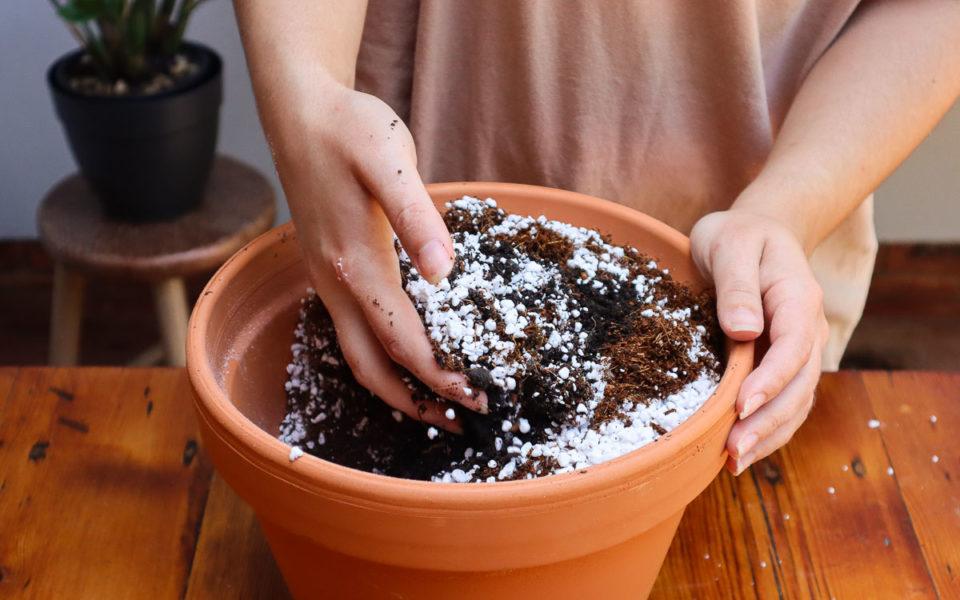
If you are new to gardening, the white particles in potting soil can be easy to mistake for fertiliser or artificial filler. They are often perlite, a lightweight material added to growing media to improve its physical structure.
Perlite can help create a looser, airier potting mix. This may be useful when soil becomes compacted, drains slowly or holds more moisture than a plant needs. However, perlite is not essential for every plant or growing setup. The right choice depends on the plant, container, base mix and watering routine.
What perlite actually is
Perlite is a naturally occurring volcanic glass. During processing, it is heated until it expands into the lightweight white particles commonly found in horticultural growing media.
The expanded material has a porous structure. In potting mixes, this helps create spaces through which air and water can move.
Perlite does not feed plants. It contains no meaningful supply of fertiliser and cannot replace compost, plant food or a suitable base mix. Its main purpose is to change how the growing medium behaves.
When a potting mix is dense or compacted, adding perlite can help keep its structure more open. This may reduce some of the problems associated with slow drainage and limited airflow around roots.
What perlite does in potting mix
Gardeners mainly use perlite to improve drainage and aeration.
In a dense potting mix, water may take too long to drain away. Adding perlite creates more open space within the mixture, helping excess water move through the container rather than remaining around the roots.
Perlite can also improve airflow within the root zone. Roots need access to both moisture and oxygen. A heavy, compacted mix may restrict that balance, particularly in containers that remain wet for long periods.
Another practical benefit is weight. Because perlite is light, it can reduce the overall weight of a growing medium. This may make larger pots and containers easier to move, although the final weight will still depend on the other ingredients and the amount of water in the mix.
Why gardeners use perlite for plants
Perlite is useful because it can be added to different growing-media combinations rather than being limited to one plant type.
Gardeners commonly consider using it when:
- A potting mix stays wet for too long.
- Soil becomes dense or compacted after repeated watering.
- A plant needs a freer-draining growing medium.
- A container mix needs more airflow around the roots.
- They want to adjust a general potting mix for a particular plant.
Perlite may be included in mixes for container plants, propagation, succulents, cacti and some indoor plants. It can also be combined with ingredients such as bark, coir or specialist potting mixes.
The important point is that perlite should support the needs of the plant. It should not be added automatically to every potting mix.
When perlite works well and when it does not
Perlite is most useful when a growing medium needs better drainage, more airflow or a looser structure. It may offer less benefit when the existing mix already drains freely.
| Growing situation | How perlite may help | What else to check |
| Potting mix stays wet for a long time | Creates a more open structure that may help excess water drain | Drainage holes, pot size and watering frequency |
| Soil becomes compacted | Helps maintain spaces within the growing medium | Quality and condition of the base mix |
| A plant prefers a freer-draining mix | Can reduce the density of the growing medium | The needs of the specific plant |
| The mix already dries very quickly | Extra perlite may make it dry too fast | Whether more moisture retention is needed instead |
Perlite cannot correct every growing problem. It does not compensate for a pot without drainage holes, an unsuitable watering routine or a poor-quality base mix.
It also does not provide nutrients. Plants still need an appropriate source of nutrition, whether that comes from a prepared potting mix, fertiliser, compost or another suitable feeding method.
The best results usually come from treating the pot, growing medium, watering routine and plant requirements as one system.
Perlite vs vermiculite
Perlite and vermiculite are often confused because both are lightweight materials used in growing media. However, they are usually chosen for different reasons.
Perlite is mainly used to create a more open mix with improved drainage and airflow.
Vermiculite generally holds more moisture within the growing medium. It may be useful where water retention is more important than faster drainage.
Neither material is automatically better. The right choice depends on what the growing medium needs to do.
Choose perlite when the mix is too dense, remains wet for too long or needs more air space. Consider vermiculite when a mix dries too quickly and would benefit from retaining more moisture.
In some growing setups, the two materials may be used alongside other ingredients. The final combination should reflect the needs of the plant rather than follow a single formula.
How much perlite to add to soil mixes
There is no universal amount of perlite that suits every plant and potting mix.
Professional horticultural practice illustrates why fixed ratios should be treated cautiously. The Australian National Botanic Gardens, for example, uses a perlite-to-coir cutting mix of 9:1 in winter but changes that formulation to 5:1 in summer. The difference shows that the appropriate growing-media balance can change with the application and growing conditions rather than following one percentage year-round.
The right quantity depends on:
- The drainage of the existing mix.
- The moisture needs of the plant.
- The size and material of the container.
- The local growing conditions.
- How frequently the plant is watered.
Start with a modest amount and mix it evenly through the growing medium. Water the pot and observe how quickly the excess drains and how long the mix remains moist.
If the soil still feels heavy, compacted or slow to drain, the mixture may need further adjustment. If it dries much faster than the plant requires, too much drainage material may have been added.
The aim is not to create the fastest-draining mix possible. It is to create the right balance of moisture, airflow and support for the plant.
For specialist plants or propagation methods, follow guidance specific to the plant and the product being used rather than relying on one general mixing ratio.
What to expect after using perlite
After perlite has been mixed through the growing medium, the most noticeable changes should be physical.
The mix may:
- Feel lighter.
- Look less dense.
- Remain looser after watering.
- Allow excess water to drain more freely.
- Be less likely to compact tightly around the roots.
These changes do not guarantee healthier plants on their own. Results still depend on the plant, pot, watering routine, light levels and nutritional needs.
You may also notice pieces of perlite moving towards the surface of the pot. This can happen because the particles are very light and may shift during watering.
Some movement does not necessarily mean the material has stopped helping the mix. However, heavily disturbed or degraded growing media may eventually need to be refreshed or replaced.
Choosing the right perlite for your setup
Perlite is available in different particle sizes or grades. The most suitable option depends on how it will be used.
A smaller particle size may blend more evenly into fine growing media, while a coarser grade can create larger spaces within a mix. Product descriptions should explain the intended use and particle size.
Before buying, consider:
- The type of plant you are growing.
- Whether the mix needs slightly better drainage or a major structural change.
- The texture of the existing growing medium.
- The size of the container.
- Whether the perlite will be combined with bark, coir or another ingredient.
Avoid choosing a product based only on the idea that more drainage is always better. A mix that drains too quickly may become difficult to manage, particularly for plants that prefer steady moisture.
Ashi Homes & Gardens offers perlite alongside vermiculite, potting mixes and other growing-media ingredients. Check the individual product information before purchasing to confirm the grade, pack size, availability and intended use.
A simple way to make soil perform better
Perlite has a straightforward role: it changes the physical structure of a growing medium.
It can help make a dense potting mix more open, improve airflow and allow excess water to drain more freely. It does not replace fertiliser, good watering habits or a suitable container.
Before adding it, start with the needs of the plant. Consider how quickly the existing mix drains, how long it remains wet and whether the roots would benefit from a more open structure.
A small, considered adjustment is usually more useful than adding large amounts without testing the result.
Browse the available perlite, vermiculite and growing-media options to compare products and choose ingredients suited to your plants and containers.





