
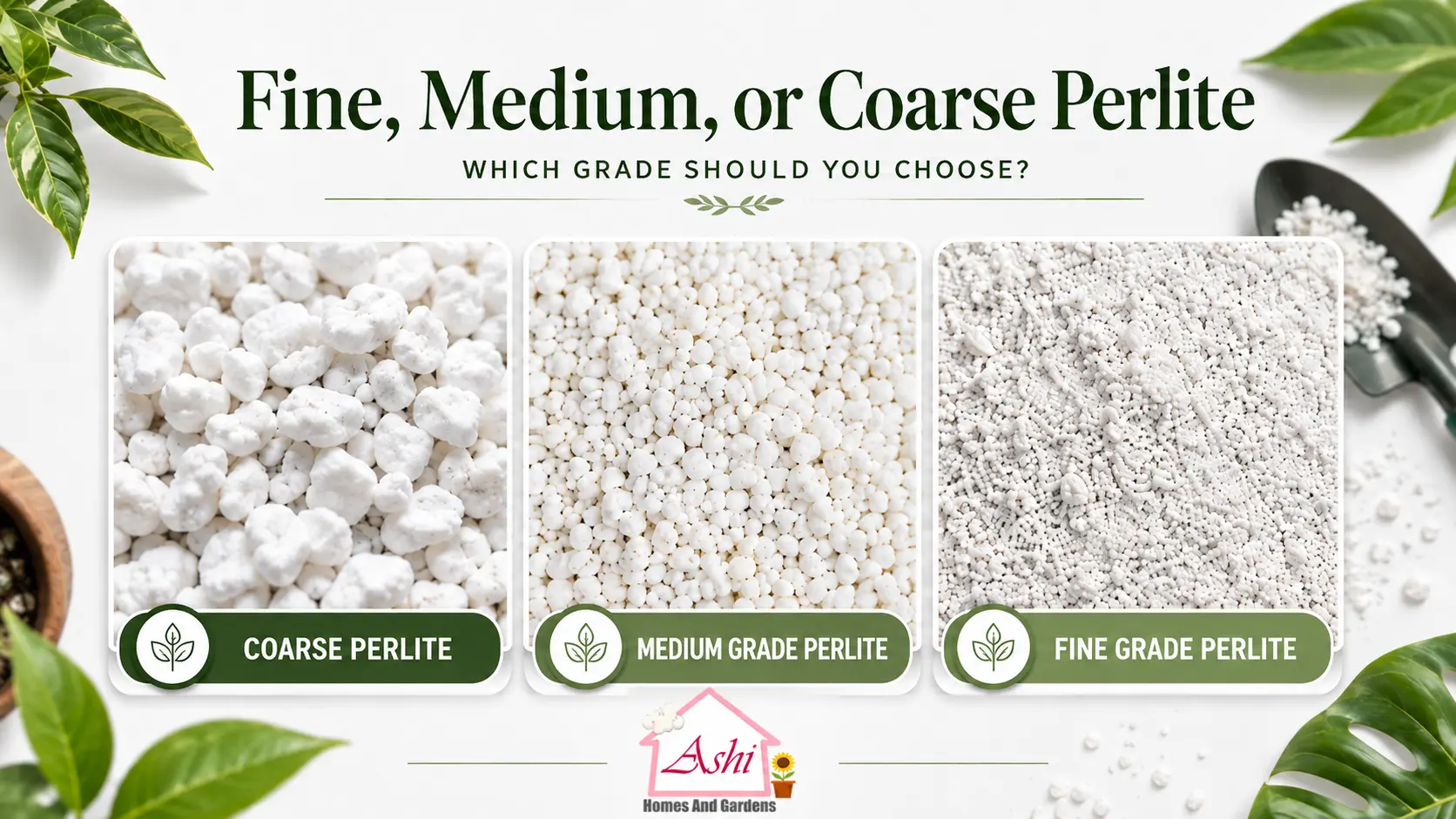
Once you understand what perlite does, the next decision is choosing the right grade. Fine, medium and coarse perlite can all improve drainage and airflow, but particle size changes how each grade behaves in a potting mix.
The right choice depends on the plant, the pot and the type of mix you are building. A finer grade creates a more subtle change, while larger particles produce a more open structure.
At Ashi Homes & Gardens, we currently stock fine perlite in 1.5–2.5 mm, medium perlite in 2–3 mm and coarse perlite in 3–5 mm. We also stock larger grades, including super coarse 5–7 mm and jumbo 6.5–10 mm.
Why perlite grade changes the way a mix performs
Perlite changes the physical structure of a growing medium.
Finer particles distribute more evenly through a mix and create a gentler change in texture. Larger particles create more separation between ingredients and produce a chunkier, more open blend.
Particle size also influences the amount of air space in a growing medium. Greenlife Industry Australia notes that air-filled porosity is affected by the range of particle sizes in a mix, with EcoHort best-practice guidelines using an air-filled porosity range of 13–30% for nursery growing media. This figure applies to the finished growing medium rather than to perlite alone, but it highlights why particle size and the balance between air and water-holding capacity matter when building a mix.
That means two mixes made with the same base ingredients can behave differently depending on the grade of perlite added.
Fine perlite is more suitable when you want a lighter adjustment without dramatically changing the texture of the mix. Coarse perlite creates a more noticeable structural change.
Choosing by grade rather than treating all perlite as interchangeable gives you more control over the final blend.
Fine perlite: where it works best
Fine perlite is a practical option when you want to lighten a mix without making it noticeably chunky.
Our fine grade has a particle size of 1.5–2.5 mm. Its smaller particles distribute evenly through finer potting media and can be useful for propagation mixes, seed-starting blends and smaller pots where larger particles may feel out of proportion.
Fine perlite can also suit growers who want a modest structural adjustment rather than a strongly aerated mix.
Its main limitation is that the smaller particles create less separation between the other ingredients than a coarse grade. In very chunky blends, fine perlite can become less noticeable within the overall structure.
For growers looking for a much more open mix, medium or coarse perlite may therefore be more suitable.
Medium perlite: the balanced middle ground
Medium perlite sits between fine and coarse grades and offers a useful balance between the two.
Our medium perlite has a particle size of 2–3 mm. It creates a more noticeable structural change than fine perlite without producing the same chunky texture as coarse perlite.
For many general indoor plant mixes, medium grade can be a practical starting point. It works well when you want to increase airflow and drainage while keeping the overall blend relatively balanced.
It may also suit growers who are still refining their potting mix and do not yet need the stronger structural effect of a coarse grade.
Coarse perlite: when bigger particles are the better choice
Coarse perlite is designed for mixes that need more separation between ingredients and a more open structure.
Our standard coarse grade has a particle size of 3–5 mm. The larger particles are more noticeable in chunky blends and can pair well with larger ingredients such as bark, coir chunks or pumice.
This is one reason coarse or chunky perlite appeals to indoor plant growers building more open custom mixes. Instead of making only a subtle change, the larger particles produce a more obvious shift in texture.
Coarse perlite is not automatically the best option for every mix. In small pots, seed trays or finer blends, the larger particle size may be more than you need.
The aim is not to choose the biggest grade available. It is to choose the grade that creates the structure you want.
Fine vs medium vs coarse perlite at a glance
The three grades are easier to compare when you look at particle size and the type of structural change they create.
| Perlite grade | Particle size | Effect on the mix | May suit |
| Fine | 1.5–2.5 mm | More subtle structural adjustment | Propagation mixes, seed-starting blends, smaller pots and finer media |
| Medium | 2–3 mm | Balanced increase in structure and airflow | General indoor plant mixes and growers wanting an all-round option |
| Coarse | 3–5 mm | More open, chunky structure with greater separation between ingredients | Chunky custom mixes and blends containing larger ingredients such as bark, coir chunks or pumice |
In simple terms, fine is the most subtle option, medium offers a balanced middle ground and coarse produces the most noticeable structural change of the three.
Which grade suits common indoor plant categories
For general houseplants and many indoor plant mixes, medium perlite can be a useful starting point because it sits between the finer and coarser grades.
If you are already building a chunkier mix using ingredients such as bark, coir chunks or pumice, coarse perlite may fit that structure more naturally.
Fine perlite can be useful in propagation and seed-starting blends because the smaller particles distribute more evenly through finer media.
For mixes where you specifically want larger spaces between ingredients, coarse perlite is the more obvious choice.
Rather than choosing by plant name alone, it is useful to consider the full mix. The base ingredients, pot size and the structure you want to create all influence which grade makes the most sense.
When coarse perlite is the right upgrade
Coarse perlite may be worth considering when a finer grade does not create enough structural change in your mix.
You may prefer coarse perlite if:
- your current blend still feels dense after adding a finer grade;
- you are deliberately building a chunky mix;
- your mix already contains larger ingredients such as bark, coir chunks or pumice; or
- you want greater separation between the ingredients in the pot.
Because coarse perlite has larger particles, the change in texture is easier to see and feel than with a fine grade.
However, a coarser grade is not automatically an upgrade in every situation. If your current mix already has the structure you want, moving to a larger particle size may be unnecessary.
How we recommend choosing between grades
Start with the structure you want from the finished mix.
If you want a subtle adjustment, fine perlite may be enough.
If you want a versatile middle option, medium perlite offers a balanced particle size.
If you are building a noticeably chunkier mix or want more separation between ingredients, coarse perlite may be the better fit.
The pot and the rest of the growing medium matter as well. A fine mix in a small pot may call for a different grade than a chunky blend made with bark, coir chunks or pumice.
Ashi Homes & Gardens is a small family-owned Australian business established in 2018. We stock multiple perlite grades so home growers and collectors can choose by particle size rather than relying on one generic option.
We also supply wholesale garden products through the same store.
Choose the grade that fits the mix
Fine, medium and coarse perlite all serve the same broad purpose, but they change a growing mix in different ways.
Fine perlite offers the gentlest structural adjustment. Medium provides a balanced option for growers who want something between the two extremes. Coarse perlite creates a more open, chunkier blend.
The best choice depends on the structure you want to create rather than simply choosing the largest or smallest particle size.
If you are still learning the basics of perlite, read Part 1 of this series first. If you already know what perlite does and are ready to compare products, browse the Perlite & Vermiculite category to compare fine, medium, coarse, super coarse and jumbo grades.
Still comparing grades? These are the questions growers usually ask before they buy
Is coarse perlite better than fine perlite?
Not by default. Coarse perlite creates a more open structure, while fine perlite makes a more subtle adjustment. The better choice depends on the mix you are building.
What is medium perlite best used for?
Medium perlite is a balanced option for growers who want more structural change than fine perlite without creating the same chunky texture as a coarse grade.
Does chunky perlite make a mix more open?
Yes. Larger particles create more separation between ingredients than finer particles, which gives the finished blend a chunkier, more open structure.
Which perlite grade is best for indoor plants?
There is no single grade that suits every indoor plant or every mix. Medium can be a practical all-round option, fine suits more subtle adjustments and coarse is better suited to mixes where a chunkier structure is the goal.
Can I mix different perlite grades together?
Different grades can be combined if you want to create a mix with more than one particle size. The final result will depend on the proportions used and the other ingredients in the blend.





