
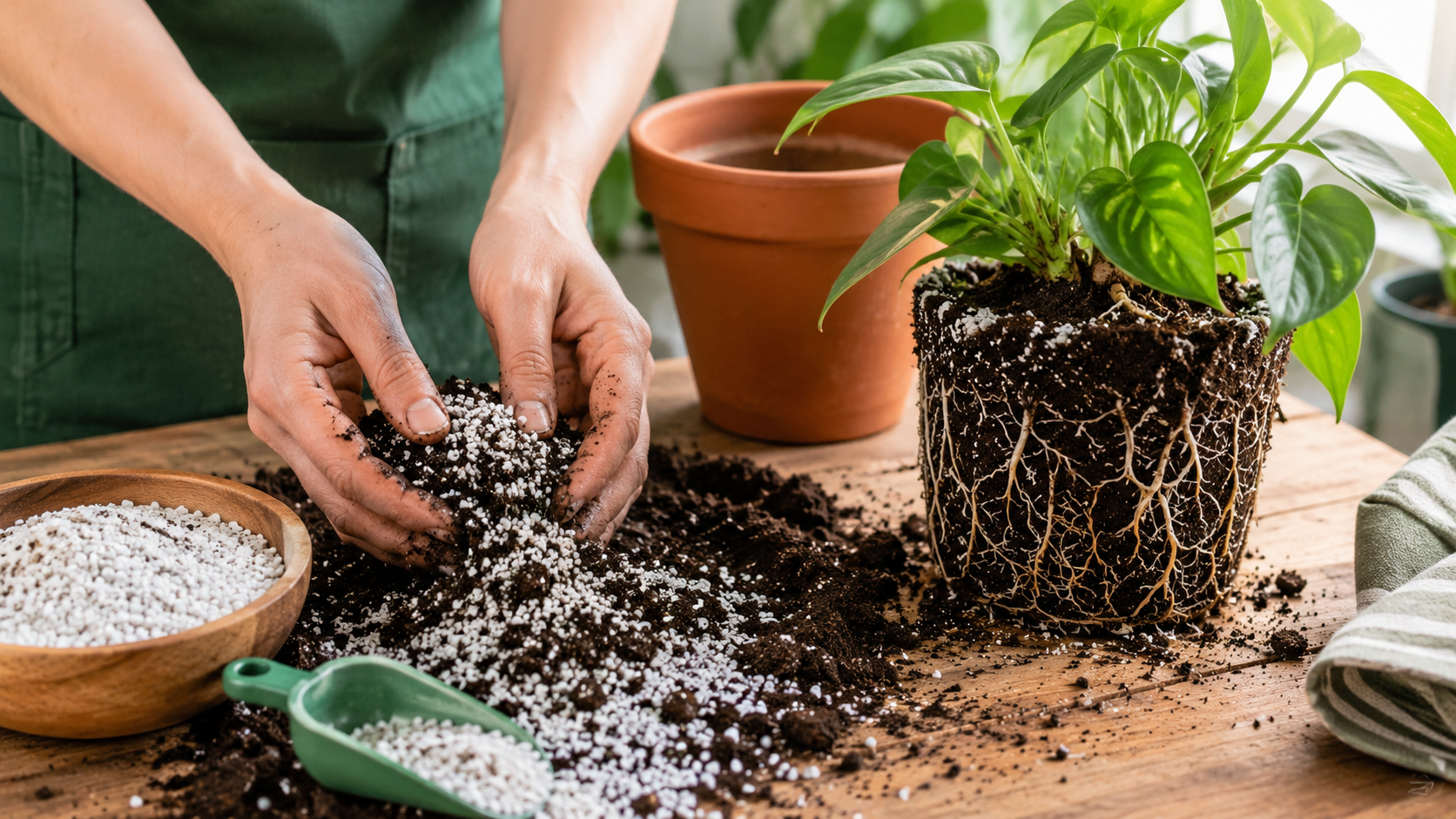
A potting mix can look fine on the surface while causing problems around the roots. It may stay wet for too long, compact after repeated watering, or dry unevenly.
Perlite can help improve the structure of the mix by creating more air space around the roots and helping excess water move through the container more freely.
But adding perlite is not simply a matter of tipping some into any potting mix. The amount, particle size, plant type and existing mix all affect the result. A chunky aroid mix, succulent blend and seed-raising mix should not all be treated the same way.
The aim is to improve the structure of the potting mix without making it unnecessarily dry or unstable.
What Perlite Changes Inside a Potting Mix
Perlite affects a potting mix in two important ways.
First, it creates more pore space within the mix, giving roots greater access to air. Second, it helps excess water move through the growing medium more freely.
Air space is an important part of how professional growing media are assessed. For example, the Australian National Botanic Gardens uses a free-draining nursery potting mix with an air-filled porosity of 15–20%, which it describes as providing good aeration and drainage. This is not a universal target for every container plant, but it illustrates why the amount of air remaining within a mix after drainage matters.
Drainage and aeration are closely connected, but they are not the same thing. A mix may drain quickly while still becoming compacted over time. Another mix may remain reasonably well aerated but dry faster than the plant needs.
That is why perlite is best treated as a structural ingredient rather than a shortcut.
If a plant is struggling because the container has poor drainage, the pot is too large or the watering routine is unsuitable, adding more perlite will not correct the underlying problem. It can improve the growing medium, but it still needs to work alongside sensible pot choice and watering.
A Simple Starting Formula for Most Container Plants
 There is no single perlite ratio in this article that can be recommended for every container plant without taking the plant, pot and existing growing medium into account.
Instead, start by assessing the base mix.
If it already feels open and drains freely, only a modest structural adjustment may be needed. If the mix feels dense, moisture-retentive or prone to compaction, more perlite may be useful.
The important point is to avoid chasing maximum drainage.
A good container mix still needs to hold enough moisture for the plant while maintaining useful air space around the roots. A blend that dries at an appropriate rate for the plant is generally more useful than one that simply dries as quickly as possible.
The table below provides a practical way to think about adjustments without relying on an unsupported universal ratio.
| Growing situation | What to consider |
| General indoor foliage plants | Balance airflow with enough moisture retention between waterings |
| Dense or compacting base mix | Consider increasing structural ingredients rather than relying on the base mix alone |
| Succulents and cacti | Prioritise a more open, faster-draining structure |
| Seed raising and propagation | Use a finer and more even texture where root contact and moisture consistency matter |
| Outdoor containers | Account for faster drying caused by heat, wind and sun exposure |
The final mix should suit the plant and growing conditions rather than follow a percentage simply because it appears in a generic recipe.
Match the Mix to the Plant, Not a Fixed Ratio
Different plants need different conditions around their roots.
Houseplants with fleshy roots, epiphytic tendencies or a dislike of prolonged wet conditions may benefit from more air in the mix. Succulents and cacti often need a more open growing medium, particularly where evaporation is slower.
Seed raising and propagation require a different approach. A finer, more even texture can be useful where moisture consistency and root contact matter alongside aeration.
Outdoor pots also need separate consideration. Wind, heat, pot material and sun exposure can cause the same growing medium to dry much faster outdoors than it would inside.
For that reason, adding more perlite is not automatically an improvement. The complete mix needs to balance airflow, drainage and moisture retention.
A more useful question is:
What does this plant need the mix to do between waterings?
That keeps the focus on the plant rather than an arbitrary recipe.
How We Mix Perlite Properly
 Perlite is lightweight, so careful mixing helps distribute it evenly.
Start with a clean mixing tub or wheelbarrow, the base potting mix and the chosen perlite grade.
If the materials are very dry and dusty, lightly dampening them before mixing can help reduce particles becoming airborne. The aim is to make them easier to handle, not to soak the mix.
Then combine the ingredients in stages.
- Add part of the base potting mix.
- Add the perlite.
- Add the remaining base mix.
- Turn the materials through several times until the perlite is distributed evenly.
- Check the texture before filling the container.
Mixing in stages helps avoid areas with large concentrations of perlite while heavier material settles elsewhere.
For propagation or finer blends, smaller perlite particles can create a more uniform texture. Chunkier grades produce more visible spaces within the mix and may be better suited to blends where a more open structure is required.
Ashi’s supplied perlite range includes fine, medium, coarse, super coarse and jumbo grades, giving gardeners different particle sizes to choose from depending on the mix they are creating.
Common Mistakes That Lead to Weak Mixes
One common mistake is adding so much perlite that the mix loses balance.
A container medium still needs enough moisture-holding material to support the plant between waterings. If the finished mix becomes too open, it may dry faster or less evenly than intended.
Another mistake is expecting perlite to rescue a poor-quality or unsuitable base mix.
Perlite can change the structure of a growing medium, but it cannot correct every weakness in the material it is mixed with. If the starting mix is badly degraded or inappropriate for the plant, the finished blend may still perform poorly.
It is also worth considering particle size rather than treating every grade of perlite as interchangeable.
Finer grades create a different structure from larger particles. The appropriate choice depends on whether the goal is a fine propagation blend, a general container mix or a chunkier growing medium with larger air spaces.
The key is to choose the grade for the job rather than assuming all perlite will behave in exactly the same way.
Signs Your Potting Mix Needs More Air
A potting mix that stays wet for a long time, becomes dense or compacts quickly may not be providing the root zone with the structure the plant needs.
Other warning signs can include a sour smell, fungus gnats, stalled growth or repeated yellowing. These symptoms can have more than one cause, so they should not be treated as proof that perlite is automatically required.
Instead, look at the whole setup.
Check how long the pot stays wet after watering. Look at whether the mix has compressed or sunk. Consider the container, drainage and watering routine as well as the growing medium itself.
A useful potting mix should remain reasonably open and easy to wet evenly without becoming excessively dry or unstable.
That is the balance to work towards.
Choosing the Right Perlite Grade
Particle size changes the structure of the finished mix.
Fine perlite provides smaller particles that can distribute more evenly through finer growing media. Medium perlite can suit general container mixing where a moderate particle size is useful.
Coarse perlite creates larger spaces within the mix, while super coarse and jumbo grades produce an increasingly chunky structure.
That means choosing the grade is just as important as deciding how much perlite to add.
Using the same volume of fine and jumbo perlite will not create identical growing media because the particle sizes change how the ingredients sit together.
Choose the grade according to the structure you are trying to create.
Build a Better DIY Potting Mix With the Right Base
Perlite works best when the rest of the growing medium also suits the plant.
If the base mix is already designed for a specific type of plant, it may only need a small structural adjustment. If you are starting with a general-purpose mix and trying to create something more specialised, the additional ingredients become more influential.
This is where making your own potting mix can be useful.
It allows you to adjust drainage, airflow and moisture retention according to the plant in front of you rather than expecting one bagged mix to perform identically in every situation.
At Ashi Homes & Gardens, gardeners can choose from different perlite grades alongside potting mixes intended for different growing situations.
When selecting a combination, consider what the base mix already provides before deciding what needs to change.
A Better Mix Starts With Better Observation
Perlite can be a simple way to change the structure of a container mix, but it works best when there is a clear reason for adding it.
Look at how quickly the pot dries.
Check whether the mix compacts over time.
Pay attention to how the plant responds between waterings.
If the growing medium needs more air space and freer movement of excess water, perlite may be a useful addition. If the container is already drying too quickly, adding substantially more may move the mix in the wrong direction.
Start with the plant, the pot, the existing mix and the watering pattern. Then choose the perlite grade and amount that best support those conditions.
For gardeners building or adjusting their own growing media, the Perlite & Vermiculite range can provide different particle-size options, while the Potting Mix range offers possible base mixes for different growing situations.
The goal is not to add perlite for the sake of it. It is to create a complete growing medium that works for the plant.





